Pièce d'argent 100ème anniversaire du Bluenose | Dollar épreuve numismatique 2021 | Monnaie royale canadienne
Related products
From vision to legacy: The Royal Canadian Mint's (RCM) Bluenose Centennial celebration begins with the 2021 Proof Dollar!
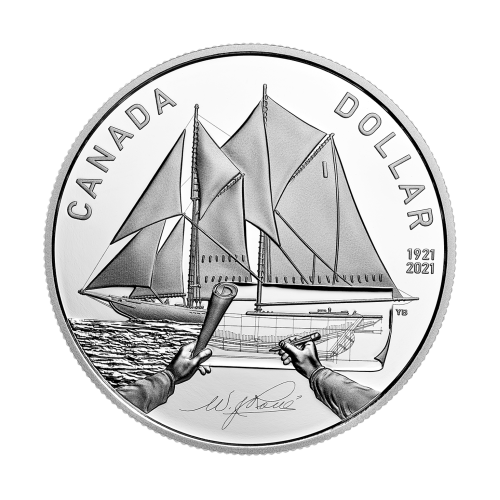
Born on a drafting table a century ago, the legacy of Bluenose was set in motion. The year 2021 marks the 100th anniversary of the launch of Bluenose, the Grand Banks fishing schooner whose racing feats and indomitable spirit earned it the title of "Queen of the North Atlantic." The first port of call in RCM's year-long celebration, the 2021 Pure Silver Proof Dollar turns back the clock to commemorate Canada's sailing ambassador, and the visionary naval architect behind its design. The Bluenose story begins here, born on a drafting table a century ago. And with the mixing of different frosting techniques (flat and traditional), your coin's engraved design simultaneously celebrates William J. Roué's vision and its fulfillment, with the birth of a racing champion.
Celebrate a beloved icon that outpaced its challengers and secured a permanent place in our hearts! Order today!
COIN HIGHLIGHTS
- THE STORY BEGINS: Start at the beginning! This proof dollar represents the first chapter of a story that continues on multiple coins in 2021. It's part of a celebration of the Bluenose journey, from design to launch and throughout its racing years, as well as its enduring legacy.
- RCM's FLAGSHIP PRODUCT: This year's pure silver proof dollar celebrates the 100th anniversary of Bluenose, the world-famous schooner whose racing success made it a beloved Canadian icon.
- PRIDE OF LUNENBURG, N.S.: Artist Yves Bérubé is based in Lunenburg, N.S., where Bluenose was proudly built and launched, and where it called home.
- MIXED FROSTING: To strike a contrast between William J. Roué's vision and its fulfillment, the first-person perspective of the design process is flat frosted while the image of the Bluenose under full sail is traditionally engraved frosted. The result is a smooth transition from concept to launch.
- A TRIBUTE TO A VISIONARY: The design includes two personal touches: the signature of naval architect William J. Roué, as it appears on Roué's hand-drawn sail plan of Bluenose.
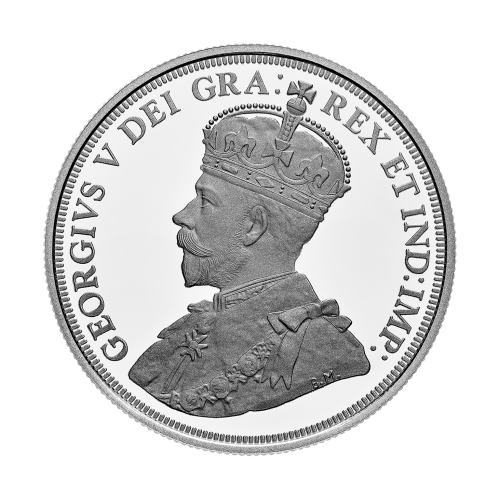
- 1921 OBVERSE: Your proof dollar features the historic effigy of George V. This is the obverse that appeared on Canadian coins in 1921, at the time of the launch.
- A HISTORICAL TREASURE: This is the ship that captured a nation's heart and lifted its spirit! Bluenose is the pride of Nova Scotia and a Canadian icon. It has also been a big part of the Royal Canadian Mint's story since 1937, when it first appeared on their 10-cent circulation coin.
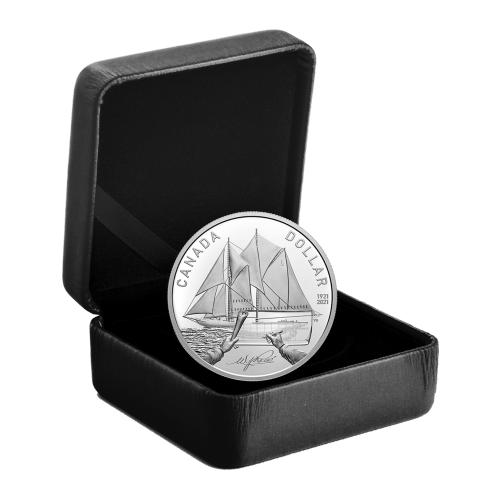
- LIMITED MINTAGE: The newest addition to your collection is crafted in 99.99% pure silver and has a limited mintage of 30,000.
COIN DESIGN
Designed by Canadian marine artist Yves Bérubé, your coin's reverse travels back in time to see naval architect William James Roué (1879-1970) completing his design for the legendary Bluenose schooner. The first-person perspective is flat frosted to distinguish between Roué's vision and the inspiring sight of Bluenose under full sail. As an added tribute, W.J. Roué's signature is included as it appeared on the original Bluenose sail plan. The obverse features the effigy of King George V by Sir E.B. MacKennal. Learn more about Canada's best-known naval architect and designer of our national icon.
"It doesn't matter which part of Canada you are from, it represented us all—and still does. I can't imagine a Canada without the Bluenose. I spent a good part of my life at sea, and so did my family. For me, the Bluenose is more than just a ship, it is a proud, beautiful symbol of history and tradition on the East Coast, where it represents every sailor, fisherman and shipbuilder." Yves Bérubé, artist
"The Proof Dollar is a significant undertaking that demands one's undivided attention and passion. The narrative surrounding the Bluenose is far-reaching, and it is a true honour to tell. My hope is that all Canadians, coast to coast to coast, will feel re-inspired by its story, and will enjoy this anniversary as much as I have." Matt Eggink, Product Manager, Royal Canadian Mint
"Bluenose is near and dear to myheart. I am a proud Nova Scotian, but the familial connection to the story makes it that much more special. The 2021 proof dollar helps keep my great-grandfather's legacy alive and represents an opportunity to re-educate Canadians on the significance of the vessel on the back of our dime. Seeing his signature on this coin is incredibly moving and very personal for the Roué family." Joan Roué, great-granddaughter of William James Roué and author of "A Spirit Deep Within", the story of Bluenose and its designer.
"William James Roué is Canada's most famous naval architect. His iconic Bluenose, launched in 1921, became and remains a famous symbol in Canada and abroad. During the 1920s and 1930s, Bluenose came to represent not only Nova Scotia, but Canada as well. The history of this schooner and its skipper Angus Walters, competing in the International Fishermen's Trophy races, has entered Canadian lore and continues to fascinate us today."Dr. Jeff Noakes – Historian, Canadian War Museum
"Bluenose represented a marriage of labour and recreation. Its success transformed public perceptions of fishermen, broke down social and cultural barriers, and transformed our national identity. A hundred years after Bluenose was launched the vessel has continued to develop in significance and has retained its status as a Canadian icon and symbol of pride." Adrian Morrison, Curator of Collections, Fisheries Museum of the Atlantic
DID YOU KNOW?
- Launched on March 26, 1921 in Lunenburg, Nova Scotia, Bluenose brought home a record catch in its first season fishing on the Grand Banks. It captured the 1921 International Fishermen's Trophy for Canada in its first season and remained undefeated in the series.
- Take a close look at the coin's reverse – notice the number "1" on the Bluenose's sail? It reflects Roué's vision of a champion. In 1921, as the challenger, Bluenose was assigned the number "2" for its inaugural race; in winning that series it earned the coveted number "1" and kept it for the rest of its racing career.
- Bluenose represented Canada at the Chicago World's Fair in 1933 and at the Silver Jubilee celebrations in 1935 for King George V, whose effigy appears on this coin's obverse.
- The famous schooner is a "Made in Canada" success story!
BUILDING A LEGACY: WILLIAM J. ROUÉ (1879-1970)
The story of Bluenose begins in 1920 with the creation of the International Fishermen's Trophy series, established to pit Nova Scotia's fishing schooners against the rival New England fleet, After an unexpected loss in the inaugural race, a group of Halifax businessmen set out to win back the trophy in 1921 by returning with a new, faster vessel. William James Roué was entrusted with the task of designing a vessel that could both earn its keep as a fishing schooner and bring the Trophy home. Born in Halifax and based in Dartmouth, N.S., Roué then worked at the family's soda manufacturing business pursuing his passion for naval architecture in his spare time. Largely self-taught, Bluenose was only his 17th design and first fishing schooner, and the one that first earned him international acclaim. Using a mathematical approach, Roué gave Bluenose the ability to carry a large amount of sail and a hull shape which would cut through the water with the least resistance, and they carried it to victory on the fishing banks and on the race course! Its success allowed Roué to turn his passion into a profession. In a career lasting more than a half-century Canada's first and most famous naval architect designed some 200 vessels, including an innovative sectional barge for Allied military use in the Second World War.
THE BUILDERS: SMITH AND RHULAND
Shipbuilding is one of Canada's oldest industries and a proud fixture of Atlantic Canada's seafaring traditions – especially in Lunenburg, Nova Scotia, home of Bluenose and a UNESCO World Heritage Site. The South Shore community was already a busy shipbuilding centre when Smith and Rhuland Shipyards opened in 1900. Known for its versatility and fine craftsmanship, the firm was awarded the contract for Bluenose in 1920. Its yards became a hub of activity and excitement as the finest shipwrights set to work using lumber from Nova Scotia, while local craftsmen stitched the sails and forged the hardware. In addition to Bluenose, Smith and Rhuland Shipyards built, launched, repaired and restored hundreds of vessels – tugs, trawlers, freighters, yachts and Grand Banks schooners, and even a famous replica of HMS Bounty. Its facilities on the Lunenburg waterfront, including the Big Boat Shed came under new ownership in the mid 1970s, but the Smith and Rhuland name remains synonymous with "the pride of Lunenburg."
A BLUEPRINT FOR SUCCESS
The hull profile engraved on your coin's reverse pays tribute to Roué's original design. Using the original hull profile blueprint the Royal Canadian Mint created a mirror image that aligns with the portrait of Bluenose under full sail.
ABOUT THE ROYAL CANADIAN MINT
The Royal Canadian Mint is known as one of the most reputable mints in the world. The Ottawa Branch of the Royal Mint opened in 1908 and was renamed The Royal Canadian Mint in 1931 when control was transferred to the Canadian government. Their high standards for excellence and quality allowed them to be the first refinery to manufacture 9999 fine gold bullion coins in 1982, as well as the first to reach 99999 fine gold purity in 1998.
