Pièce 1 once d'argent Le centenaire de l'Aviation royale canadienne 2024 | Monnaie royale canadienne
Related products
Look to the skies, as we commemorate the RCAF’s legacy of service.
Higher, faster, farther—such is the pathway to the stars, Sic Itur ad Astra, a fitting motto for one of Canada’s most renowned institutions! Now in its centennial year (1924-2024), the Royal Canadian Air Force (RCAF) continues to proudly serve Canadians and the world, taking part in search-and-rescue missions and NATO training programs, disaster relief and peacekeeping operations, and even providing space power support to the Canadian Forces, proving the sky is no longer the limit for Canada’s Air Force.
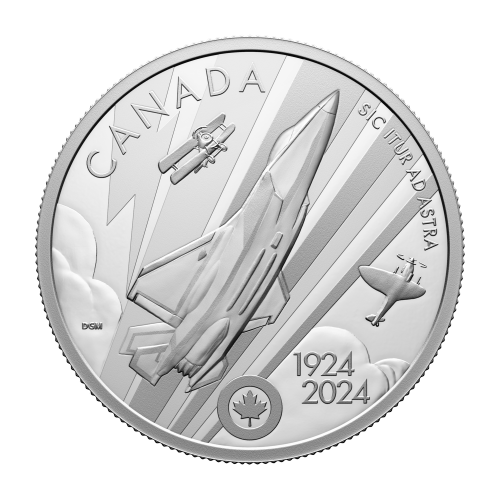
This 99.99% pure silver collectible honours the RCAF’s distinguished history and heritage on its retro-style reverse, where the illustrative art style spans three different eras of RCAF aircraft history and captures the pulse-pounding thrill of flying.
Experience the rush and commemorate 100 years of RCAF history.
COIN HIGHLIGHTS
- Commemorate the RCAF Centennial. In 2024, the RCM look to the skies and commemorate the Royal Canadian Air Force’s (RCAF) 100 years of service, at home and abroad. The RCAF Centennial is an opportunity to honour the history and heritage of Canada’s Air Force, and to recognize its members’ contributions to military and civil aviation, national security and international peace.
- Retro-style art. Your coin’s reverse radiates a palpable energy—one can practically hear the roar of the engines as these aircraft soar to greater heights! While the retro art style is fun and engaging, the stylized rendering nonetheless captures the true form of each aircraft.
- Modern meets traditional engraving. Traditional engraving brings the different aircraft to life on your coin’s reverse, which also features laser engraving and special frostings to help distinguish select design elements.
- Complete your collection of RCAF Centennial coins. This fine silver coin continues the theme featured on the 2024 Proof Dollar—in fact, the RCAF Centennial commemorative pieces are our only aviation-themed coins in 2024. They tell a story that is sure to captivate collectors of all ages, and thanks to its unique design, this particular piece is a great opportunity to share your hobby with budding collectors.
- Limited mintage. Only 12,000 coins are available to collectors worldwide.
- Affordable keepsake. Issued in the same month as the official arrival of the RCAF’s 100th anniversary (April 1, 2024), this fine silver keepsake makes a great gift for family and/or friends who have served/are serving in the RCAF.
- Includes serialized certificate. The Royal Canadian Mint certifies all of its collector coins.
- No GST/HST.
PACKAGING
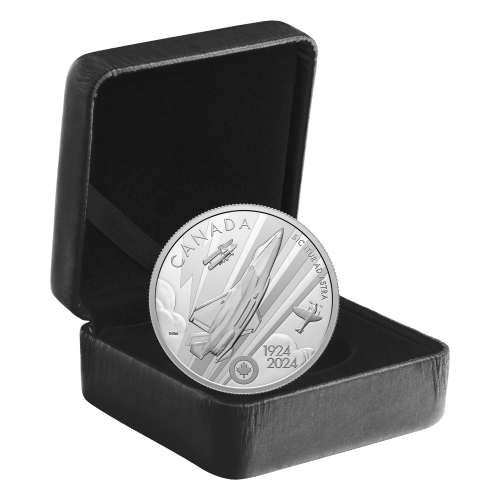
Your coin is encapsulated and presented in a black Royal Canadian Mint-branded clamshell with a black beauty box.
ONE DESIGN, THREE ERAS OF AIRCRAFT HISTORY
Representing 100 years of RCAF history, your coin’s reverse features three different fighter aircraft: the Sopwith Camel of the First World War and the RCAF until 1929; the Supermarine-designed Spitfire fighter flown in the Second World War; and the Lockheed Martin F-35 Lightning II that represents the future of RCAF aircraft.
DID YOU KNOW?
Of the 17 RCAF fighter squadrons serving overseas during the Second World War, 14 flew the Spitfire in combat.
Credited with being flown to shoot down more enemy aircraft than any other allied type, the Camel was named for the bump caused by the fairing covering the two machine guns on the nose of the aircraft.
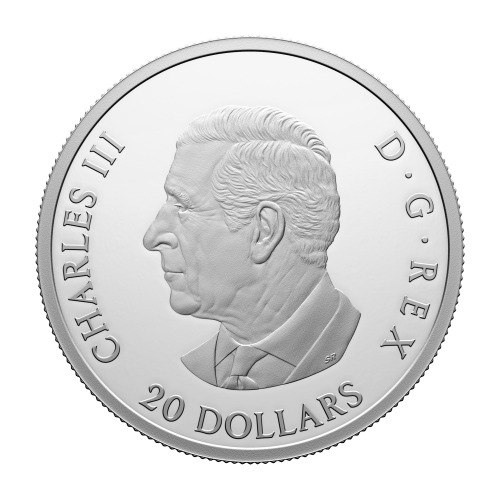
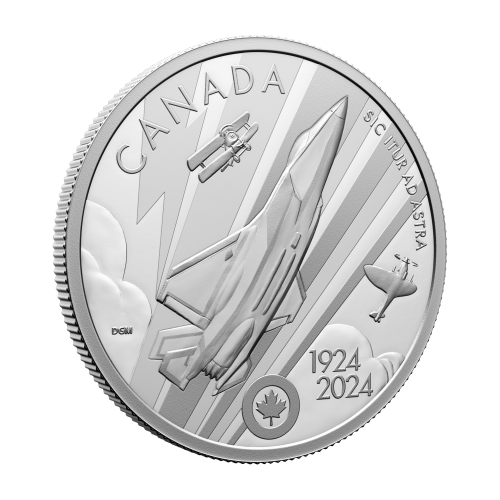
A salute to the Royal Canadian Air Force’s (RCAF) 100 years of service (1924-2024), the reverse design by artist David Moore spans three different eras of RCAF aircraft history. Backed by angular shapes conveying speed and motion, two of the aircraft speak to the RCAF’s past: on the left, the Camel was flown as a fighter aircraft in the First World War and as an advanced combat trainer with the RCAF until 1929; and on the right, the Spitfire fighter was flown in combat by RCAF squadrons overseas in the Second World War. The F-35 Lightning II—the inspiration for the lightning bolt in the background—is prominently featured in the foreground, where the stealth fighter represents the RCAF’s future fleet. The RCAF motto “Sic Itur ad Astra” (“Such is the pathway to the stars”) is positioned near the top, while the RCAF roundel is centred at the bottom. The obverse features the effigy of His Majesty King Charles III by Canadian artist Steven Rosati.
ABOUT THE ROYAL CANADIAN MINT
The Royal Canadian Mint is known as one of the most reputable mints in the world. The Ottawa Branch of the Royal Mint opened in 1908 and was renamed The Royal Canadian Mint in 1931 when control was transferred to the Canadian government. Their high standards for excellence and quality allowed them to be the first refinery to manufacture 9999 fine gold bullion coins in 1982, as well as the first to reach 99999 fine gold purity in 1998.
