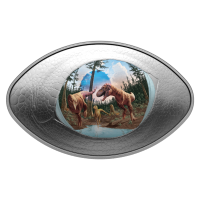
1 oz 2025 Dinosaur Eye Oval Shaped Proof Silver Coin | Royal Canadian Mint


Related products
See the prehistoric world through the eye of a top predator.
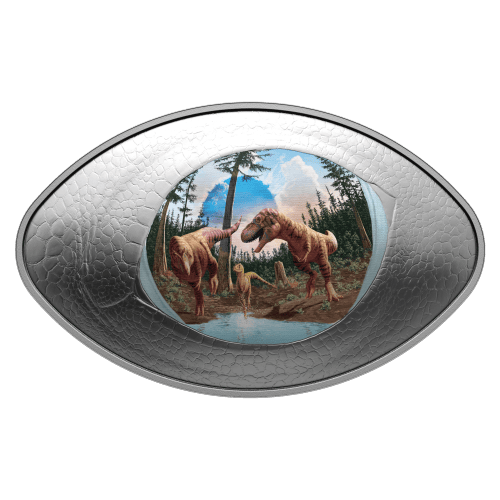
Travel back to an age when dinosaurs ruled the Earth and see the world as they saw it! With each new fossil discovery, paleontologists are able to piece together new information about what the world looked like millions of years before us, and this oval-shaped coin presents a view of that long-gone reality. Its oval outline is perfectly shaped for an extreme close-up of the eye (and scaly eyelid) of Thanatotheristes, the most ancient Canadian tyrannosaur and the top predator of its time. For another view of this species, take a closer look at the colourful reflection in the eye—you’ll notice that this fearsome two-legged carnivore wasn’t travelling alone.
The oval shape returns—this time, as a dinosaur eye.
COIN HIGHLIGHTS
- A realistic dinosaur eye. Shaped like a tyrannosaur eye, this 99.99% pure silver coin transports you back in time to when dinosaurs roamed the earth!
- Royal Canadian Mint's second curved, oval-shaped coin for this size. The oval shape from our 2017 football coin is back, and this time, the curved outline and convex reverse lend themselves beautifully to a realistic rendering of a dinosaur eye.
- Scientifically accurate. The artist is a well-known Canadian paleoartist. Your coin’s reverse design was also reviewed by the Royal Tyrrell Museum of Palaeontology, which was involved in identifying this tyrannosaur species.
- For dinosaur lovers of all ages. Dinosaurs are always a popular theme with collectors and Canadians of all ages, and they’re an important part of Canada's natural heritage.
- A limited collectible. Only 8,500 coins are available to collectors worldwide.
- Includes serialized certificate. The Royal Canadian Mint certifies all of its collector coins.
- No GST/HST.
PACKAGING
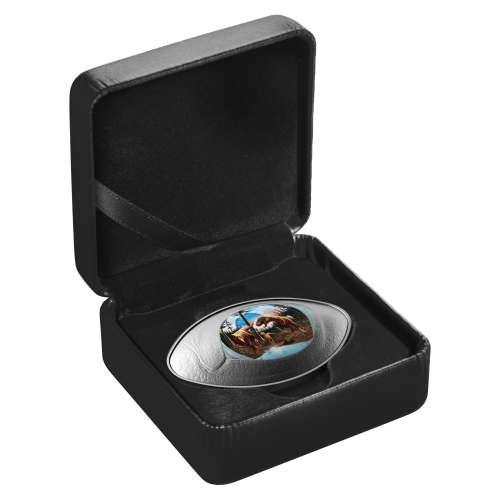
Your coin is encapsulated and presented in a black Royal Canadian Mint-branded clamshell with a black beauty box.
AN 'EYE' FOR DETAILS
The reverse features an outstanding amount of finely engraved details that re-create Thanatotheristes’s scaly skin and eye area, while the centre portion is coloured to provide a stunning view of the prehistoric world reflected in the dinosaur’s eye.
DID YOU KNOW?
Measuring up to 10 metres in length and weighing up to 2.5 tonnes, Thanatotheristes (“Reaper of Death”) lived roughly 79.5 million years ago, which makes it one of the world’s oldest tyrannosaur species. As an apex predator, this toothy, two-legged carnivore preyed on herbivores such as Colepiocephale and Xenoceratops. Fossil remains discovered in the Foremost Formation, along the Bow River in Alberta, led to its naming in 2020, making it the most recently described tyrannosaur from Canada.
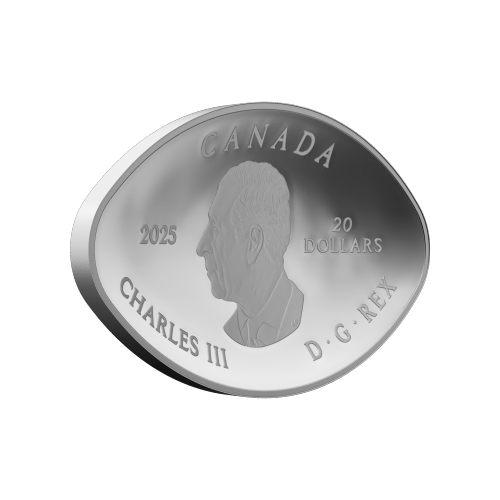
Designed by Canadian paleoartist Julius Csotonyi, this oval-shaped coin’s reverse is a close-up of a tyrannosaur eye, specifically that of Thanatotheristes degrootum—the most ancient tyrannosaur species discovered in Canada, and also the most recently named (2020). While the skin and eyelid are covered in fine (engraved) scales, the dinosaur’s surroundings are colourfully reflected in the eye itself, revealing the presence of other individuals of this species, as they move through the swampy forests of Cretaceous Western Canada. The obverse features the effigy of His Majesty King Charles III by Canadian artist Steven Rosati.
ABOUT THE ROYAL CANADIAN MINT
The Royal Canadian Mint is known as one of the most reputable mints in the world. The Ottawa Branch of the Royal Mint opened in 1908 and was renamed The Royal Canadian Mint in 1931 when control was transferred to the Canadian government. Their high standards for excellence and quality allowed them to be the first refinery to manufacture 9999 fine gold bullion coins in 1982, as well as the first to reach 99999 fine gold purity in 1998.